
A Guide to Residential Home Styles in the Washington DC Metro Area
The Washington DC Metro area, known to locals as the DMV (DC/MD/VA), is one of the most architecturally diverse housing markets in the country. From early twentieth-century streetcar suburbs to sprawling postwar subdivisions and today's high-design new construction, the region's neighborhoods tell the story of how Americans have lived for more than a century. Whether you’re searching for homes for sale in the District, exploring Montgomery County real estate, or touring listings across Fairfax County, understanding residential home styles helps you recognize exactly what you are looking at and what to expect in terms of layout, character, and long-term value. This guide walks through fifteen of the most common detached single-family home styles you will encounter across the DC Metro area.
1. Colonial Revival
The Colonial Revival is the workhorse of DMV real estate and arguably the most recognizable home style across the Washington DC Metro area. Inspired by early American Georgian and Federal architecture, it features a strictly symmetrical facade, a centered front door, evenly spaced windows, and a rectangular two-story form topped by a side-gable roof. Shutters, dentil molding, and a modest entry portico are common finishing touches, and exteriors are frequently brick or painted clapboard. You will find Colonial Revival homes in nearly every corner of the region, from established neighborhoods in Alexandria and Bethesda to newer subdivisions across Fairfax, Loudoun, and Prince George's counties. Buyers gravitate toward the style for its timeless curb appeal and its practical interior layout, which typically places formal living and dining rooms on the first floor with bedrooms upstairs. For families searching for homes for sale in the DC suburbs, the Colonial remains a perennial favorite.
2. Rambler / Ranch
The Ranch, known throughout the DMV as the Rambler, defined suburban expansion across the region during the 1950s and 1960s and remains a market staple today. These homes are long, low, and single-story, with an emphasis on horizontal lines, an attached carport or garage, and an easy indoor-outdoor flow. Here is an important local note for buyers touring Ranch and Rambler homes in the Washington DC Metro area: many of these homes are built over a full basement, often a walk-out or daylight level depending on the slope of the lot. That lower level frequently doubles the usable square footage and is commonly finished into a recreation room, additional bedrooms, or an in-law suite, which means the modest footprint you see from the curb can conceal a great deal of living space below. Because everything essential can live on one level, Ramblers are especially popular with buyers seeking single-level living or aging-in-place potential, while the basement offers room to grow. Neighborhoods throughout Montgomery County, Fairfax County, and the close-in suburbs are rich with well-built mid-century Ramblers.
3. Cape Cod
The Cape Cod is a compact and enduring style that filled DMV neighborhoods during the 1940s and 1950s, particularly in the housing boom that surrounded World War II. Recognizable by its steep side-gable roof, one-and-a-half-story massing, central chimney, and symmetrical front, the Cape Cod often features dormer windows that bring light and headroom into the upper level. The classic layout places a living room and one or two bedrooms on the main floor, with additional bedroom space tucked under the sloped roof upstairs. Many Cape Cods across the Washington DC Metro area have been thoughtfully expanded over the decades with rear additions and dormer build-outs, making them a favorite entry point for buyers seeking charm and value in close-in communities like Arlington, Alexandria, Falls Church, and Silver Spring. Their manageable size and solid construction make them both approachable and highly renovatable.
4. Split-Level
The split-level is one of the most distinctive silhouettes in the Washington DC Metro area, easy to recognize once you know what to look for. Rather than stacking floors directly on top of one another, a split-level staggers its living spaces across three or more levels connected by short half-flights of stairs. You typically enter at the main level, where the kitchen and primary living areas sit on grade, then step up a half-flight to a bedroom wing and down a half-flight to a family room, laundry, or garage. This design gained popularity through the 1960s and 1970s because it separated the home into functional zones, giving quiet sleeping areas real distance from busier living and utility spaces. The staggered floor plan also adapts beautifully to the sloped and rolling lots found throughout the region. Split-level homes remain abundant across Fairfax County, Montgomery County, and Prince George's County, and buyers appreciate how naturally the layout suits families and multigenerational living. For those searching homes for sale in the DC suburbs, a well-maintained split-level offers generous, well-organized space that many single-story or conventional two-story homes cannot match.
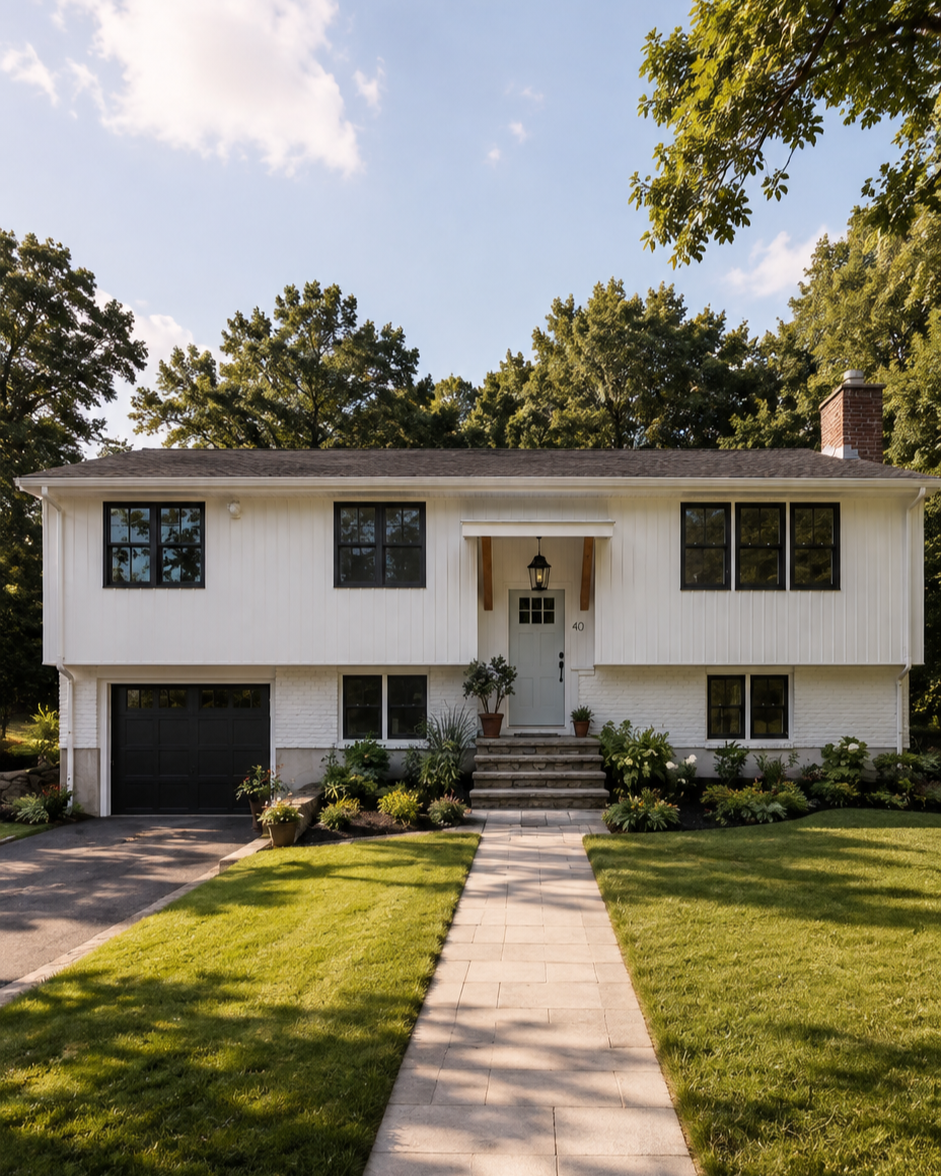
5. Split-Foyer / Bi-Level / Raised Ranch
The split-foyer is frequently confused with the split-level, but it is a distinct style worth understanding on its own, especially since it goes by several names. Also called a bi-level or a raised ranch, the split-foyer greets you with a small entry landing immediately inside the front door, positioned between two levels. From that landing, one short staircase rises to the main living level and another descends to a finished lower level. This clever design became popular across the Washington DC Metro area because it delivered two full floors of living space at an economical price point, with the lower level set partly above grade so that windows bring in real natural light rather than the dim feel of a traditional basement. That lower level is commonly finished into a family room, additional bedrooms, a home office, or an in-law suite, effectively doubling the usable square footage. Split-foyer homes appear in large numbers throughout Fairfax County, Montgomery County, and Prince George's County, particularly in neighborhoods built from the 1960s into the 1980s.
6. Craftsman
The Craftsman style grew out of the early twentieth-century Arts and Crafts movement and is prized across the DMV for its handcrafted character and warmth. Hallmarks include a low-pitched gable roof with wide overhanging eaves, exposed rafter tails and decorative brackets, a broad front porch supported by tapered columns set on masonry piers, and an emphasis on natural materials such as wood, stone, and brick. Inside, Craftsman homes often showcase built-in cabinetry, rich wood trim, and a fireplace positioned as the heart of the living space. Some of the region's most beloved Craftsman and Craftsman-influenced homes around Washington DC line the streets of early streetcar suburbs like Takoma Park, Del Ray in Alexandria, and portions of Chevy Chase and Cleveland Park. For buyers searching for historic character homes in the Washington DC Metro area, a well-preserved Craftsman offers architectural detail that is difficult and expensive to replicate in new construction.
7. Victorian
Victorian architecture predates the automobile suburbs and represents some of the oldest detached housing stock in the DMV. Rather than a single look, Victorian is a family of ornate nineteenth-century styles, with Queen Anne being the most recognizable. Expect asymmetrical massing, steep and complex rooflines, decorative wood trim known as gingerbread or spindlework, wraparound porches, bay windows, and the occasional turret. These homes were built to impress and reward buyers who love detail and history. Takoma Park, which straddles the DC and Maryland line, holds one of the region's densest and best-preserved collections of Victorian homes, and pockets of Victorian architecture also appear in the historic cores of Alexandria and other older town centers. Owning a Victorian in the Washington DC Metro area often means stewarding a genuine piece of local history, and many of these homes sit within designated historic districts that carry preservation guidelines worth understanding before you buy.
8. Mid-Century Modern
Mid-Century Modern holds a special place in DMV architecture and deserves a careful definition. Every authentic mid-century modern home in the region was built during the 1950s and 1960s, but the reverse is not true: the vast majority of homes constructed in those decades are conventional Ramblers, Cape Cods, and Colonials rather than genuine mid-century modern. True Mid-Century Modern is defined by post-and-beam construction, flat or low-slope rooflines, walls of glass that dissolve the boundary between inside and out, open floor plans, and a purposeful integration with the natural landscape. The Washington DC Metro area is home to several nationally significant planned Mid-Century Modern communities, including Hollin Hills in Alexandria, Carderock Springs and Hammond Wood in Montgomery County, Holmes Run Acres in Fairfax County, and Rock Creek Woods. These homes attract design-focused buyers who value architectural authenticity, and demand for original mid-century modern homes in the DMV consistently outpaces the limited supply. Preserving original features such as clerestory windows, tongue-and-groove ceilings, and floor-to-ceiling glazing is central to both their character and their value.
9. Contemporary (70’s/80’s)
Contemporary refers to a specific and instantly recognizable era of home design that took hold across the DMV in the 1970s and 1980s, and it carries a look all its own. These homes are angular and dramatic, built around steeply pitched, asymmetrical rooflines and bold intersecting geometric planes. Their defining material is wood: natural or stained vertical cedar siding wraps most examples, often paired with clerestory and angled windows that trace the slope of the roof, generous skylights, and soaring vaulted ceilings framed by exposed beams. Many were designed with passive-solar principles in mind, a direct response to the 1973 energy crisis, and builders frequently tucked them into wooded, sloping lots so the architecture settled naturally among the trees. The result is a home that feels warm, woodsy, and organic rather than sleek or minimal. The Washington DC Metro area holds one of the country's deepest supplies of this style, anchored by Reston, the planned community where the wooded contemporary became a signature, with strong concentrations also found in Lake Barcroft, Great Falls, the wooded pockets of Potomac, and Columbia, Maryland.
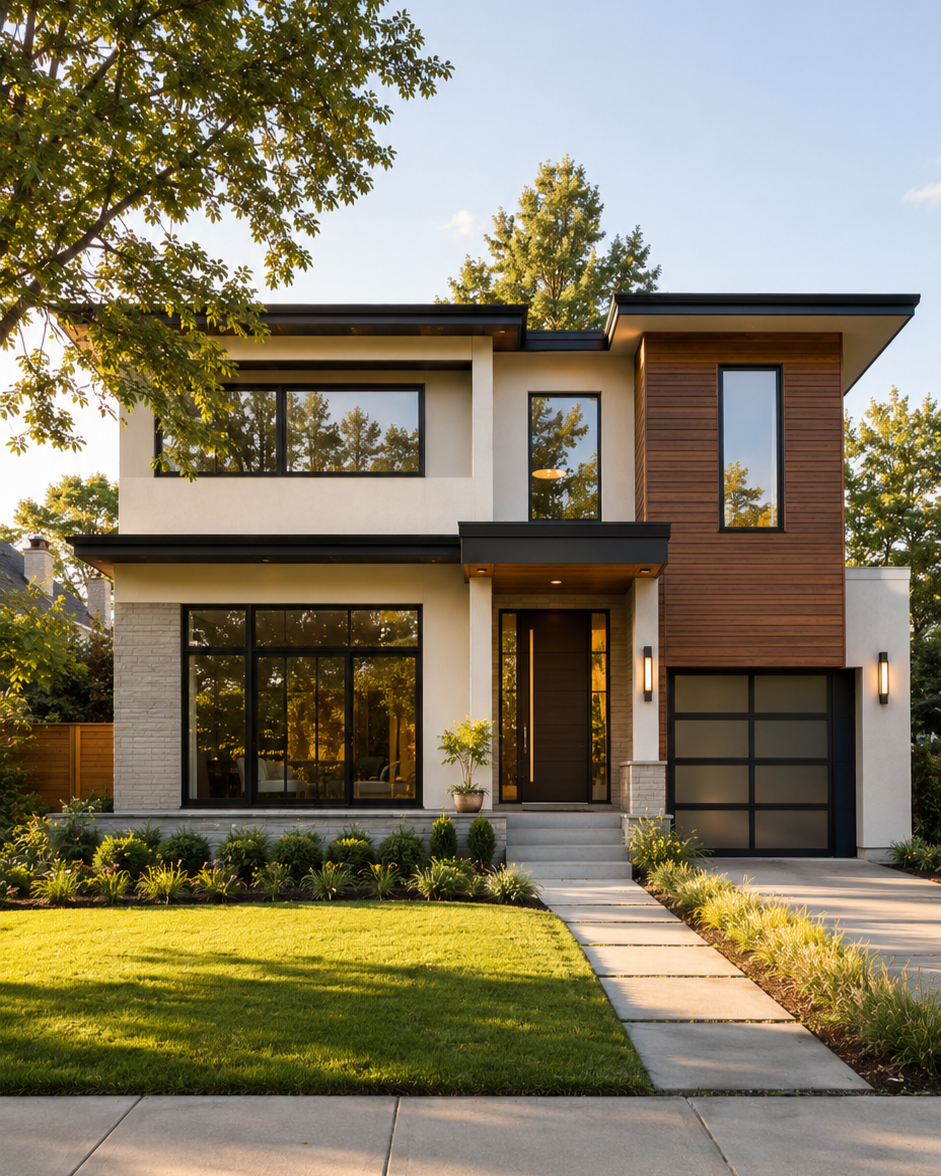
10. Modern
Modern is the style of the present moment, and in the DMV it shows up most often in custom builds and teardown-and-rebuild infill projects. Unlike historical styles that reproduce a specific era, Modern homes prioritize clean geometry, open-concept interiors, oversized windows, and a deliberate mix of exterior materials such as fiber cement, metal, stone, and wood. Rooflines are frequently flat, shed, or low-slope, and the overall aesthetic favors light, volume, and connection to the outdoors. As land values have climbed inside the Beltway, Modern new construction has become increasingly common in Arlington, McLean, Bethesda, and close-in Alexandria, where builders replace smaller postwar homes with larger, energy-efficient modern residences. Buyers drawn to Modern homes in the Washington DC Metro area typically value flexible living space, abundant natural light, and up-to-date systems over traditional ornamentation.
*Mid-Century Modern vs. Contemporary vs. Modern: Understanding the Labels: Mid-Century Modern, Contemporary, and Modern are constantly lumped under the single word "modern," which is where most of the confusion starts. The cleanest way to keep them straight is by era, because each term belongs to a different chapter in the same ongoing story of modern residential design. Mid-Century Modern refers to the original modernist homes of the 1950s and 1960s: low, horizontal, post-and-beam structures with walls of glass. Contemporary describes the angular, cedar-clad homes of the 1970s and 1980s, with their steep asymmetrical rooflines, exposed beams, and woodsy character. Modern is the term most people now use for today's newly built homes, defined by clean boxy massing, flat roofs, large expanses of glass, and black-framed windows in a mix of stucco, metal, and fiber cement. The trap is the word itself. "Contemporary" literally means "of the current moment," so a home built in 1978 and a home built this year were both labeled contemporary the day they were finished, even though they look nothing alike. Dating a house by its defining features, rather than by the label attached to it, is the surest way to know what you are really looking at.
11. Bungalow
The Bungalow is closely related to the Craftsman and often overlaps with it, but the term refers more to the home's form than to any single set of decorative details. A Bungalow is a modest one or one-and-a-half-story home with a low-slung profile, a prominent front porch, and an efficient floor plan in which the main living spaces sit on a single level. Many DMV bungalows carry Craftsman detailing, while others lean toward simpler Colonial or vernacular trim. Built primarily in the early decades of the twentieth century, bungalows populate the region's older streetcar neighborhoods and appeal to buyers seeking walkable communities and human-scaled homes. You will find charming bungalows for sale in areas like Takoma Park, Del Ray, and Brookland in Northeast DC, among other established close-in neighborhoods. Their approachable size, front-porch culture, and strong renovation potential make them a durable favorite in the Washington DC Metro area housing market.
12. American Foursquare
The American Foursquare is easy to spot once you know the form: a boxy, two-and-a-half-story home with a nearly square footprint, a low hipped roof, a single central dormer, and a full-width front porch. The name comes from the efficient interior layout, which typically divides each floor into four roughly equal rooms. Popular from roughly 1900 into the 1930s, the Foursquare offered generous space on a compact urban lot, which made it ideal for the DMV's growing streetcar suburbs. These homes deliver high ceilings, ample natural light, and a sense of solidity that many buyers find deeply appealing. American Foursquares appear throughout older communities across the Washington DC Metro area, including neighborhoods in the District itself, Takoma Park, and the historic sections of Arlington and Alexandria. For buyers who want classic early-twentieth-century character paired with practical square footage, the Foursquare is a compelling option.
13. Modern Farmhouse
The Modern Farmhouse is one of the most in-demand styles in DMV new construction today, blending rustic warmth with clean, updated lines. Exteriors typically feature crisp white or light-toned board-and-batten siding, black-framed windows, a metal-accented or standing-seam roof element, and a welcoming covered porch. Inside, the style favors open-concept living, shiplap accents, oversized kitchen islands, and a bright, airy palette. While it borrows visual cues from traditional rural farmhouses, the Modern Farmhouse is thoroughly contemporary in its layout and finishes. Across the Washington DC Metro area, builders have embraced the style for both custom homes and infill projects in communities like Arlington, Falls Church, Vienna, and throughout Loudoun and Fairfax counties. Buyers searching for new construction homes in the DMV are frequently drawn to the Modern Farmhouse for its move-in-ready appeal and its balance of character and modern function.
14. Mediterranean / Tuscan Revival
The Mediterranean and Tuscan Revival style brings a note of southern European elegance to the DMV, most often in upscale and custom-built homes. Defining features include low-pitched clay or barrel-tile roofs, stucco exteriors, arched windows and doorways, wrought-iron accents, and warm earth-toned palettes. Some examples incorporate interior courtyards, loggias, or ornate iron balconies that evoke the villas of Italy and Spain. Although the style is less common here than across the Sun Belt, Mediterranean and Tuscan Revival homes appear in luxury enclaves and estate communities throughout the Washington DC Metro area, including Potomac, McLean, and Great Falls. For buyers seeking distinctive luxury homes in the DMV, a Mediterranean-inspired residence offers a striking alternative to the region's more traditional brick Colonials.
15. Tudor Revival
The Tudor Revival stands among the most romantic and instantly recognizable home styles in the Washington DC Metro area, evoking the storybook charm of old English cottages and manor houses. Defining features include steeply pitched roofs, prominent front-facing gables, decorative half-timbering set against stucco or brick, tall narrow windows often grouped together with diamond-shaped or casement panes, and massive ornamental chimneys. Rounded arched doorways and a mix of stone, brick, and stucco on the same facade give Tudors a rich, textured look that feels handcrafted and substantial. The style flourished across the DMV during the 1920s and 1930s, and some of the region's finest examples anchor prestigious close-in neighborhoods such as Spring Valley, Forest Hills, and Chevy Chase, along with pockets throughout Arlington and older sections of Montgomery County. Because relatively few were built compared to Colonials and Cape Cods, well-preserved Tudor homes in the Washington DC Metro area tend to command attention and hold their appeal with buyers who love character, history, and architectural detail.
Finding the Right Style for You
From century-old Victorians to brand-new Modern Farmhouses, the Washington DC Metro area offers a remarkable range of residential architecture, and each style carries its own character, layout, and lifestyle. Knowing how to identify these homes makes touring listings more rewarding and helps you focus your search on the styles that genuinely fit how you want to live. If you are exploring the DMV real estate market and want a knowledgeable local guide to help you find the right home in the right neighborhood, I would be glad to help you get started.
Are you thinking about buying or selling in the DC metro area?
