
The Window Problem in DMV Mid-Century Homes: What Local MCM Owners Need to Know
Every mid-century owner in this region has the same February evening. You are standing in a room with a wall of glass, wearing a sweater indoors, watching condensation run down an aluminum or steel frame and pool on a sill that has been quietly darkening for years. And you think: these windows have to go.
Slow down. In this market, that decision is worth real money in both directions.
I sell mid-century modern homes across the DMV for TTR Sotheby's International Realty, and the window question comes up in nearly every one of them. Buyers ask about it during showings. Inspectors flag it. Sellers who handled it well get paid for it, and sellers who handled it badly find out at the offer table.
This is the local version of that conversation. Not the general internet advice written for a Palm Springs house with different weather and different rules, but what actually applies to a Goodman house in Alexandria or a Bennett house in Bethesda.
What We Are Working With Here
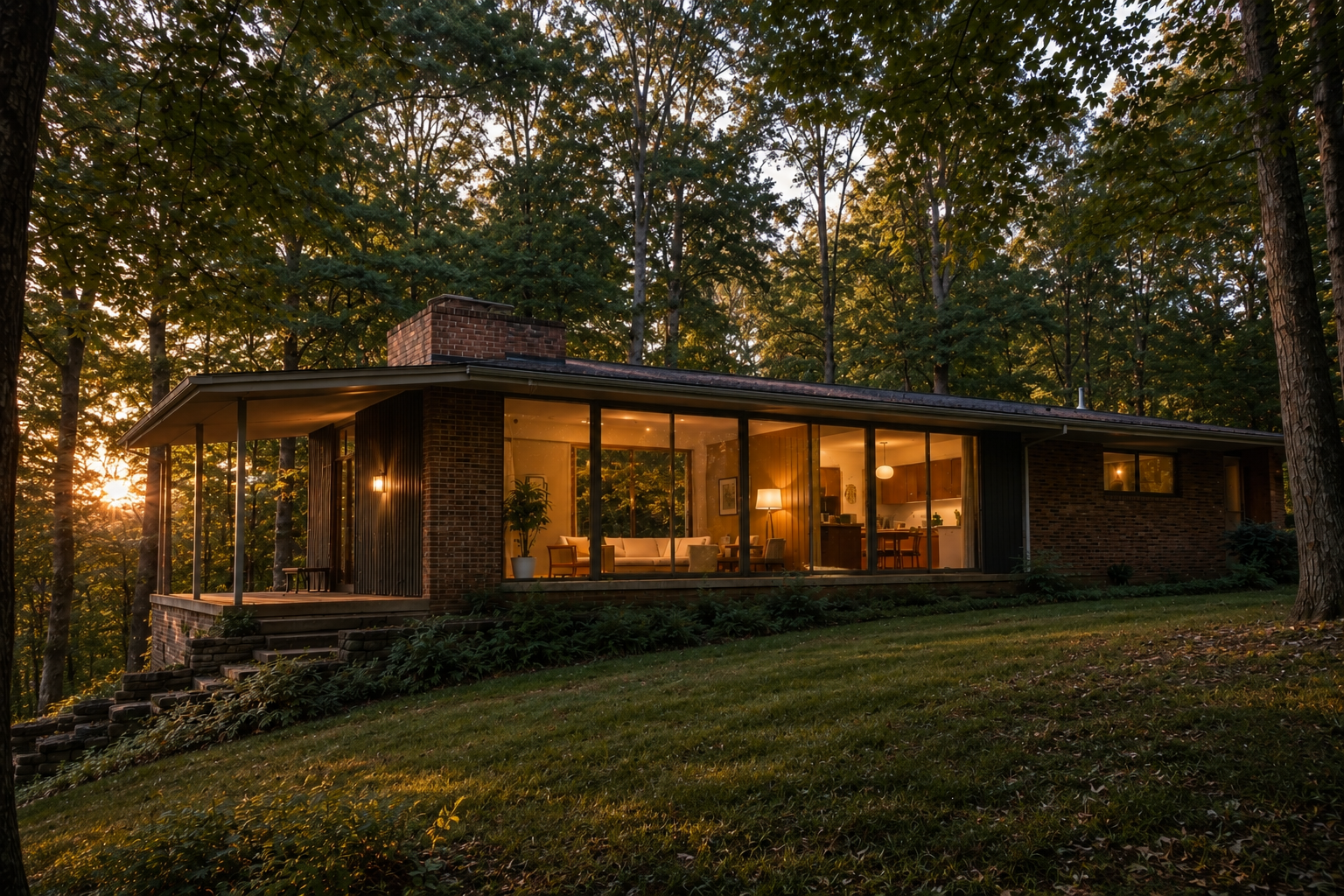
The DMV's mid-century inventory is not desert modernism and it does not behave like it.
Our defining figure is Charles M. Goodman, who did more than anyone to bring modernist design to the middle-class Washington buyer. With developer Robert Davenport he built Hollin Hills in the Fort Hunt area of Fairfax County, more than 450 homes constructed between 1946 and 1971 on 326 acres, sited individually to follow the topography rather than flattened into a grid. He designed Holmes Run Acres in Fairfax County, Hammond Wood in Silver Spring, 58 houses built between 1949 and 1951 across 15 wooded acres, and Rock Creek Woods north of Kensington, roughly 74 houses built between 1958 and 1961 by the Blumberg brothers of Bancroft Construction in a valley between two creeks.
Then there is the Edmund Bennett and Keyes, Lethbridge & Condon line of work, most visibly Carderock Springs in Bethesda, 275 modernist houses developed between 1962 and 1966 on 146 acres of sloping wooded land. Add New Mark Commons in Rockville, and the many unprotected pockets of modernism scattered through Falls Church, Arlington, Silver Spring, and Potomac, and you have a substantial regional inventory.
What these homes share is the thing that creates the problem. Expansive glass walls. Wide roof overhangs. Sculptural chimneys. Open plans engineered to erase the line between inside and outside. The glass is not decoration on these houses. It is the entire architectural argument.
It is also single-pane, set in frames with no thermal break, designed when heating oil was cheap and nobody was calculating a U-factor.
Our Climate Changes the Answer
Most of the mid-century window advice online was written for California. Some of it actively misleads a DMV owner.
We sit in a mixed-humid climate, generally IECC climate zone 4A. That means we carry a real heating load and a real cooling load, and unlike Palm Springs, our dominant enemy is not solar gain.
Three local realities follow from that.
Tree canopy is doing work that glass upgrades cannot. Hammond Wood sits under mature oak and beech. Rock Creek Woods occupies a wooded valley. Carderock Springs was deliberately planned around existing trees. That canopy plus Goodman's deep overhangs already provides substantial summer shading. The aggressive solar-control films and very low solar heat gain glass that make sense on a west-facing wall in the desert can leave a shaded DMV house darker and colder in January without solving much in July. Where a desert owner optimizes for blocking sun, we generally want low-e coatings tuned to retain heat while still admitting winter light. Tell your glass supplier the climate zone and the exposure, and ask specifically what solar heat gain coefficient they are proposing and why.
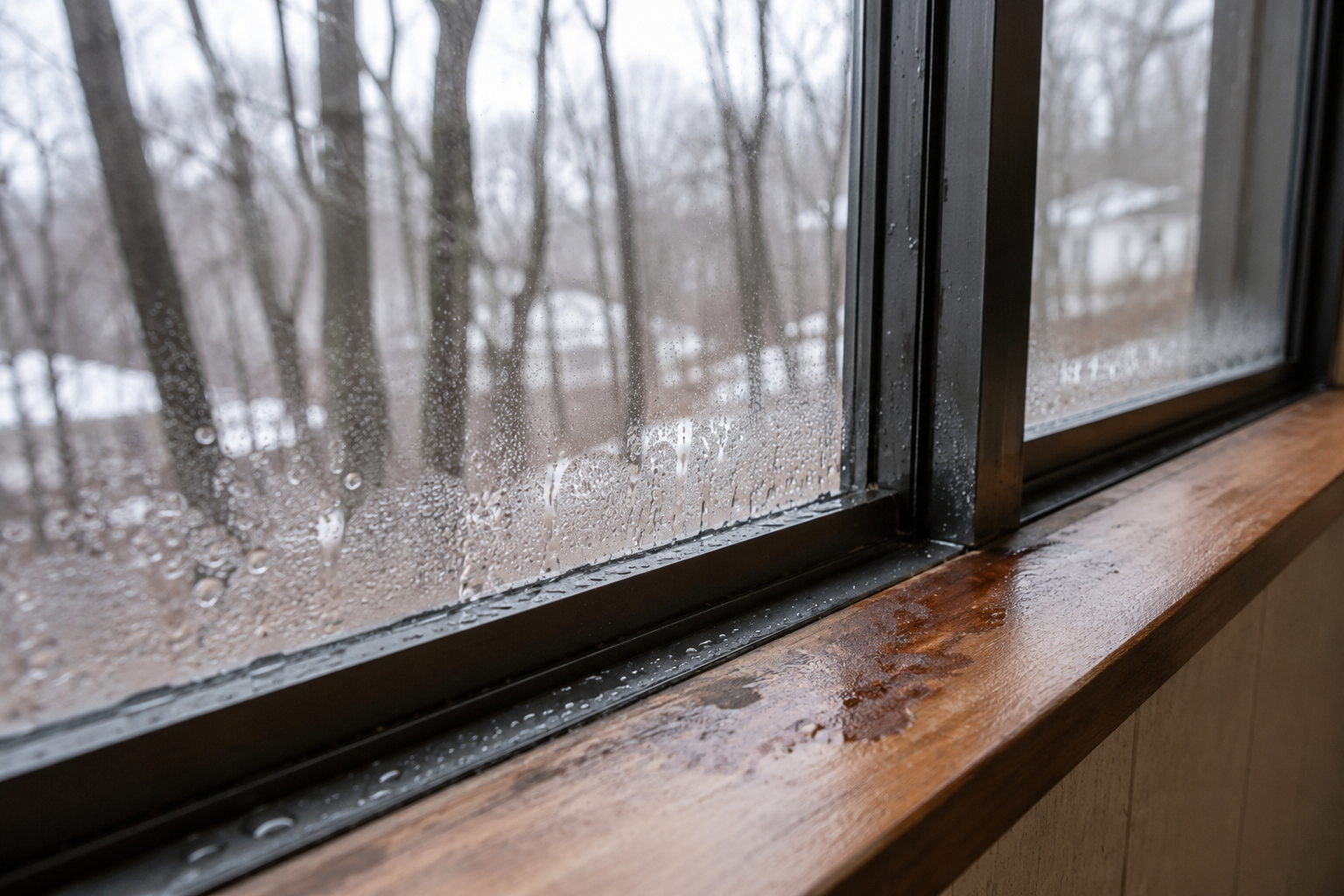
Humidity makes condensation a rot problem, not a nuisance. Warm, moist interior air hits a cold single-pane surface or a bare metal frame and gives up its moisture. In a dry climate that is an annoyance. Here, in a house with wood sills, wood paneling, and mature landscaping holding moisture around the foundation, that water feeds rot and mold behind drywall. If you have dark staining below a window or a sill that gives under thumb pressure, you have moved past a comfort conversation.
Wind-driven rain is the water test that matters. We have no wildfire glazing code and no hurricane impact requirement in most of the region. What we do have is sustained storm-driven rain against large glazed elevations, which means flashing and sill-pan detail on any window work matters more here than glass specification does. More DMV mid-century window projects fail from water intrusion than from disappointing energy numbers.
Check Your Review Status Before You Check Your Budget
This is where DMV owners get surprised, and it is the single most important paragraph on this page.
Hollin Hills has two overlapping layers of review. Since 1950, exterior changes have been governed by protective covenants in the property deeds, administered by the Civic Association's Design Review Committee. Separately, on March 8, 2022, the Fairfax County Board of Supervisors designated Hollin Hills a Historic Overlay District, which brings exterior modifications under review by the county's Architectural Review Board. Window replacement on a Hollin Hills house is a reviewed action, and the board's own meeting records show applicants proposing contemporary thin-profile windows specifically to match existing steel. That is the standard being applied. Plan for it.
Montgomery County operates through the Historic Preservation Commission and the Historic Area Work Permit, or HAWP. Exterior work on properties listed on the county's Master Plan for Historic Preservation, whether as individual sites or as contributing properties inside a historic district, requires HPC approval before the permit issues.
Here is a distinction that trips up a lot of owners, including some agents. National Register listing alone does not restrict what you do to your own house. Hammond Wood, Rock Creek Woods, and Carderock Springs are all National Register districts, listed in 2004, 2004, and 2008 respectively. That listing is an honor and a marketing asset. It is the separate local designation that carries the permitting requirement. Do not assume either way based on the National Register plaque. Confirm your specific parcel's local status with the county before you spend a dollar.
Holmes Run Acres has been through Historic Overlay District evaluation, however, the residents ultimately rejected the HOD in 2022, out of fear the designation’s restrictions would impede on the home’s values; It would have prevented sales to developers whose sole intent would be to tear down the original MCM homes and replace them with uninspired mcmansions.
Everywhere else, and this covers a lot of excellent DMV modernism in Falls Church, Arlington, Silver Spring, and Potomac, you likely have no design review at all. You still have a building permit, an energy code, and safety glazing requirements. And you still have a market that notices.
The practical rule: call the county or city historic preservation office, give them your address, and ask two questions. Is this parcel subject to design review for exterior alterations, and does replacing windows trigger it. Ten minutes on the phone before you take bids will save you months.
The Code Items Nobody Mentions Until Inspection
Three requirements catch DMV mid-century owners regularly:
Safety glazing. Modern code defines hazardous locations that require tempered or laminated glass. Those include glazing in and adjacent to doors, large panes with a low bottom edge over a walking surface, and glazing near wet areas and stairs. Goodman houses, built around floor-to-ceiling glass and glass immediately beside doors, are full of these locations. Your original annealed glass is grandfathered exactly as it sits. The moment you replace it, the new glass must be tempered or laminated. This is one of the most commonly omitted line items in a cheap bid, and it is not negotiable at inspection.
Bedroom egress. Sleeping rooms require an emergency escape opening with a minimum net clear opening of 5.7 square feet, at least 24 inches of clear height and 20 inches of clear width, with the sill no higher than 44 inches. Mid-century bedrooms with fixed picture windows or high clerestory bands frequently fail this. Replacing a fixed unit with another fixed unit can put you offside where the original was grandfathered in. A casement conversion is usually the least expensive path to compliance.
Energy code. Virginia, Maryland, and DC all run IECC-derived codes, generally landing around a U-factor of 0.30 for replacement fenestration in our climate zone. Verify the adopted code year with your jurisdiction, because the specifics move.
And one structural item. In post-and-beam construction, the header above a window wall can carry roof load, and there is often no conventional rough opening. If you are pulling out a full glass wall or changing an opening size, you need a structural engineer. Many mid-century window projects in this region are quietly structural projects, and finding that out mid-demolition is expensive.
Your Options, Cheapest to Most Expensive
Most owners think they have two choices. There are more, and the middle of the range is where most DMV homes should land.
Do nothing structural, improve the mechanicals. Cellular shades, a modern heat pump, and attention to the rest of the envelope. A properly sized heat pump handles loads the original system never could. Zero visual impact, fully reversible, no gain in the glass itself.
Restore what you have. Reglazing, weatherstripping, hardware repair, steel stripping and refinishing, and wood repair with epoxy consolidants. Professional window restoration averages roughly $300 to $550 per window, with steel casement work running substantially higher, often several hundred dollars per pane once rust repair enters the picture. Old-growth wood and quality steel, properly maintained, outlast most replacements by decades.
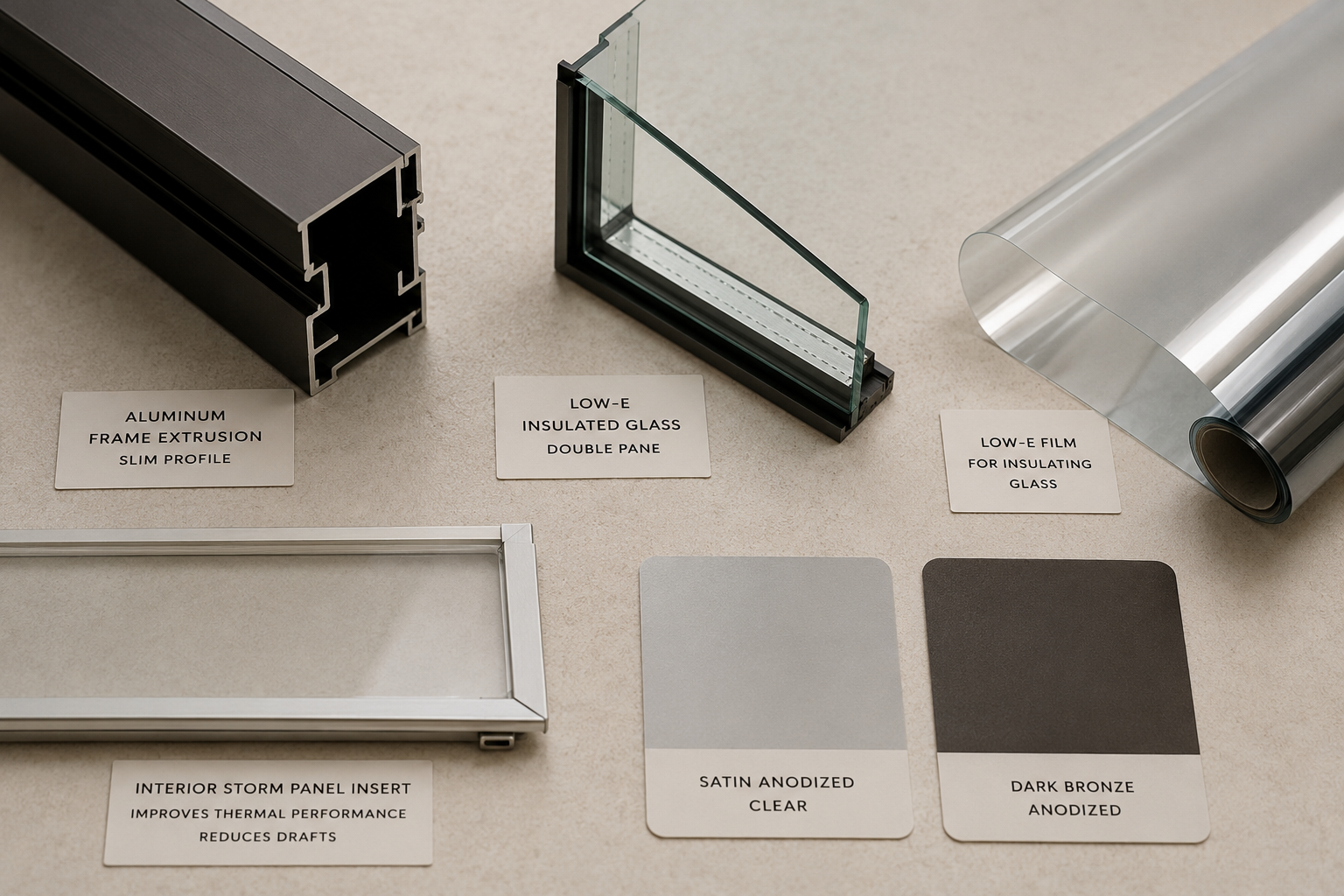
Add interior storm panels. This is the most underused option in the region and the best comfort-per-dollar move for a typical DMV mid-century house. Interior magnetic or track-mounted inserts add a second glazing layer with no exterior change whatsoever, which also makes it the easiest thing to get approved in Hollin Hills or a Montgomery County historic district. Pacific Northwest National Laboratory research published through ENERGY STAR found low-e storm windows improve U-factor by 47 to 61 percent over non-metal primary windows and 53 to 63 percent over metal primary windows, with a 10 to 20 percent reduction in whole-building air leakage, and found them cost-effective across IECC zones 3 through 8. We are zone 4. Budget roughly $250 to $500 per window installed.
Apply low-e film. A quality low-e film can push a single-pane window's U-factor toward roughly 0.6, closing much of the gap to a dual-pane unit, at roughly $7 to $13 per square foot installed. It blocks up to 99 percent of ultraviolet radiation, which protects paneling and furnishings. Safety-film versions hold shattered glass together, which is partial mitigation for annealed glass, though it does not make the glass code-compliant. In our shaded neighborhoods, choose a low-e product for heat retention rather than a dark solar-control film.
Retrofit insulated glass into the existing frames. Where a frame can accept a thicker unit, a glazier removes the exterior trim, sets a one-inch low-e tempered insulated unit directly into the existing opening with no added division bars, and reinstalls the trim. The original sightlines survive completely. Not every frame accepts it, and most operable aluminum sashes cannot, but for large fixed panes it is close to ideal. Expect roughly $3,000 to $5,000 per large panel.
Replace with a period-appropriate modern system. Slim thermally broken aluminum or steel from manufacturers like Fleetwood, Western Window Systems, Arcadia Custom, Milgard, and Blomberg on the aluminum side, or Hope's, Crittall, and Optimum for steel. Finish matters as much as profile: satin anodized for period fidelity, dark bronze or matte black for deliberate contrast against brick and wood. Costs run roughly $2,000 to $3,500 per casement or awning unit in high-cost metros, with sliding glass walls at roughly $800 to $2,000 per linear foot, meaning a 12-foot opening lands somewhere between $10,800 and $24,000 before finish work. These figures come from cost guides skewed toward expensive coastal markets, so treat them as directional and get three local bids.
Replace with stock vinyl. Cheapest, code-compliant, warrantied, and the fastest way to reduce what your house is worth. More on that below.
Or do the smart thing and mix them. Restore or properly replace the street-facing and architecturally significant glass. Use storm panels, film, or retrofit glass on the rear and side elevations nobody photographs. This hybrid approach is almost always the best allocation of a fixed budget, and no contractor bidding a whole-house job has any incentive to suggest it.
Why Vinyl Costs You at Resale Here
Let me be direct about the market consequence, because this is where my job intersects with your renovation.
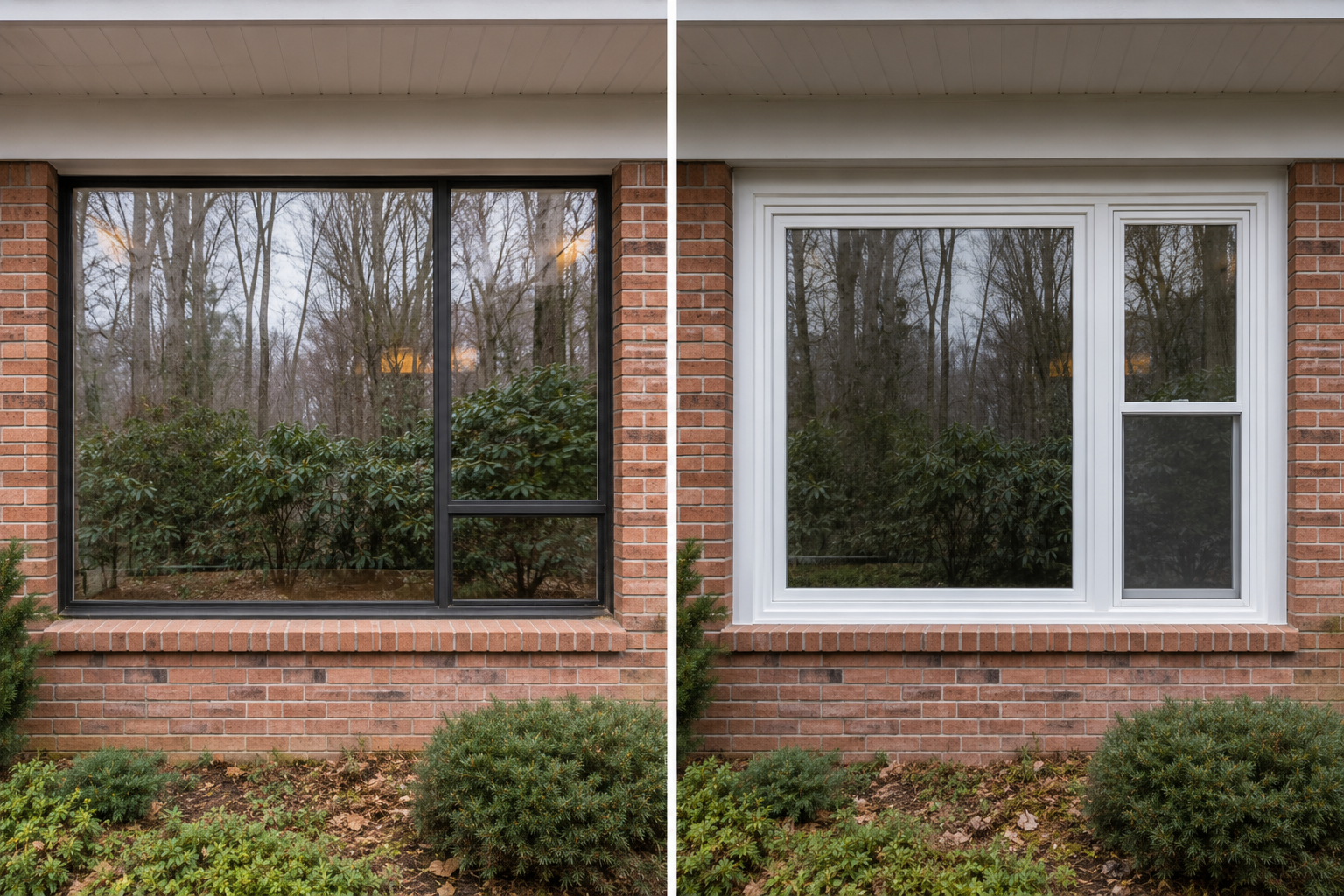
Stock vinyl and heavy fiberglass frames are visually bulky because they have to be. They need mass to carry dual-pane glass. Set one into a Goodman opening and two things happen at once. The thick frame creates a picture-frame border that interrupts the long horizontal lines the whole house depends on, and the frame steals glass area, shrinking the actual visible glazing inside the same rough opening. You lose the line and you lose the light in one move.
The DMV mid-century buyer pool is small, informed, and specific. These are people who sought out Hollin Hills or Carderock on purpose, who can name the architect, and who are frequently comparing two or three houses in the same neighborhood at the same time. When one of those houses has thin original or sympathetically matched sightlines and the other has white vinyl, the response is not subtle. It shows up in showing feedback, in days on market, and in the offer.
Thoughtfully restored originals and well-matched slim replacements hold or add value. Bulky replacements measurably do not. And unlike a paint color or a countertop, this one is not correctable without doing the entire job over.
If budget forces a compromise, put the compromise on the back of the house.
The Order to Do This In
If you are living in one of these homes and trying to decide where to start, this sequence works for most DMV properties.
Handle safety and water first. Rot, leaks, failing sills, and any pane that is both large and directly over a walking surface. This is not deferrable.
Confirm your review status. One phone call to the county. Do it before you order anything.
Walk the house and rank the elevations. Which glass is street-visible and architecturally significant, and which faces the back fence. Write it down. This document alone changes how contractors bid.
Put storm panels or low-e film on the worst glass and live through a season. A full DMV winter and a full DMV August. A meaningful number of owners find this captures most of the comfort they were missing, at a fraction of replacement cost, fully reversibly.
Then decide on replacement, with a year of real experience and an honest picture of which frames have actually failed versus which are simply old.
When you do hire, ask to see three mid-century projects with photographs of the finished glazing. Look for heads aligned to beams, ceilings running continuously to the exterior, and thin sightlines. Ask how they will detail sill flashing, whether they will provide shop drawings and NFRC-labeled product data, whether they have tested for asbestos in pre-1980 glazing putty, and what the glass seal warranty term specifically is. Insist on a per-opening cost breakdown rather than a lump sum. A contractor who leads with vinyl or who tells you that you do not need a permit for windows is telling you exactly what their standard of care will be on everything else.
Thinking About Buying or Selling One of These Homes?
The window question is not a side issue in a DMV mid-century transaction. It is frequently the largest single variable in the condition of the house, and it is one that a general-practice agent will look right past.
If you are buying, you should know before you write an offer whether you are looking at original glass, a 1980s replacement, or a project that will require Architectural Review Board approval and six figures. If you are selling, you should know which improvements the mid-century buyer pool will actually pay for and which ones are money you will not see again.
I specialize in mid-century modern homes across DC, Maryland, and Northern Virginia with TTR Sotheby's International Realty. If you own one of these houses, or you are trying to buy one, I am happy to walk it with you and give you a straight read on where the glass stands.
Reach out for a conversation about your mid-century home
Outside the DMV? For mid-century specialists in other markets nationwide, see MCMAuthority.com.
